Professor Daisuke Katagami, Department of Engineering, Faculty of Engineering
Tomoki Miyamoto, The University of Electro-Communications
Manaka Uno, Graduate School of Engineering,
Tokyo Polytechnic University
This study developed a role-play training system for dementia care, focusing on "Humanitude"—which emphasizes non-verbal communication—and the activation of mind-reading through role-playing experiences. The results were widely disseminated through a paper presentation at the international conference HAI 2025 and an interactive exhibition at "Everyone's Neuroscience 2025." At the exhibition, nearly 100 participants experienced conversing with an AI, and this initiative won the "Neurodiversity Award 2025" (ranking in the top 3.5% of 170 entries from 10 countries). The award ceremony was broadcast via press release on PRTIMES, and an interview was published as a web article related to the project, demonstrating high social recognition.
< Purpose of Publication >
The purpose is to disseminate accurate knowledge about dementia to prevent conflicts in family caregiving and reduce the psychological burden on caregivers. It also aims to foster empathy for the patients' feelings, allowing caregivers to explore and practice better caregiving methods. Furthermore, by providing an opportunity to understand the difficulties of family caregiving before directly facing them, this project contributes to alleviating the isolation and hardships of caregiving environments, which have become a major social issue.
< Necessity and Significance >
With the growing number of elderly individuals with dementia and their family caregivers, measures to prevent caregiving conflicts caused by a lack of understanding are urgently needed. The publication of these results is highly significant as it aids caregivers in learning about and deeply understanding dementia, helping them accept the condition at an early stage. Additionally, this research addresses an essential theme for an aging society, and we are confident it will evolve into a new flagship research area for the university in the field of welfare-support AI.
< Originality, Innovativeness, and Creativity >
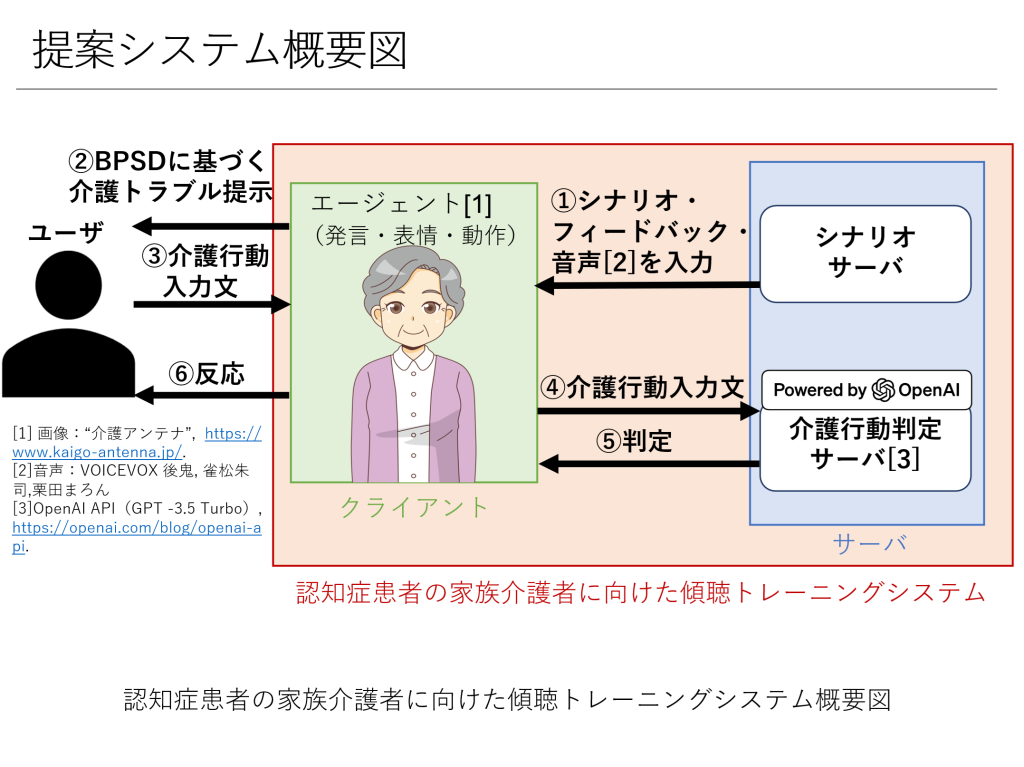
The originality lies in integrating the validation method for reducing BPSD (Behavioral and Psychological Symptoms of Dementia) with the Humanitude concept, which emphasizes non-verbal information. By utilizing real-time voice communication with an AI agent, the role-playing system provides a highly practical and effective learning experience. Backed by international awards, this approach is highly innovative compared to conventional welfare support systems.